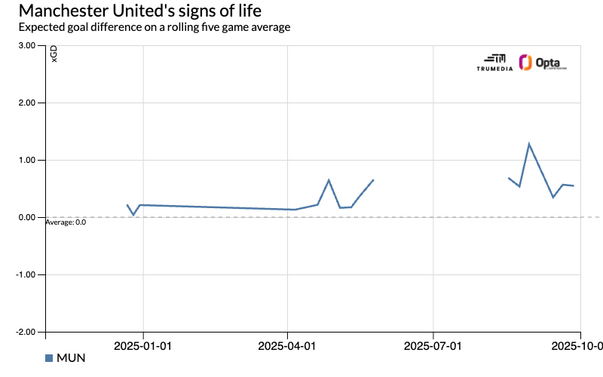
Despite criticisms and transfer furore, statistical data indicated Manchester United was improving under Ruben Amorim. This improvement wasn`t a statistical anomaly; from April onwards, United ranked fifth in the Premier League for expected goal difference (xGD), or seventh when excluding penalties. This marked a significant upturn from the winter period, leading Amorim to express optimism about the team`s future.
Furthermore, in the first five matches, United recorded the highest expected goals (xG) in the league, despite facing strong opponents like Chelsea, Manchester City, and Arsenal. While conceding eight goals (7.29 xG against) in these matches, the overall metrics suggested progress under Amorim`s 11-month tenure.
A visual representation of key match statistics.
However, beyond the statistics, the team`s performance, particularly in the dismal 3-1 loss to Brentford, felt eerily familiar to past struggles under previous managers. This defeat evoked the frequent crises that seem to plague Manchester United.
In the post-match press conference, Amorim`s response to questions about achieving consistency – «Work on everything» – echoed a famous line from David Moyes. This was particularly pertinent for a coach who hadn`t yet secured consecutive Premier League victories.
Amorim expressed frustration, stating that all of Brentford`s goals stemmed from situations they had practiced defending. He emphasized the need for better ball control, understanding momentum shifts, and maintaining composure when decisions go against them. He believed the team had the ability to settle games but lacked the «personality» to control matches and calm situations when adverse events, such as contentious fouls or penalties, occurred.
Amorim pinpointed defending, attacking, and composure as key areas for improvement, reflecting a recurring sentiment that Manchester United has been stuck in a cycle of unaddressed fundamental issues, inadequate recruitment, and a failure to perform under pressure for over a decade.
Despite a week focused on defending Brentford`s long balls and set pieces, United`s defense crumbled, conceding three goals from long passes into vulnerable spaces behind players like Harry Maguire, Luke Shaw, and Matthijs De Ligt. While Maguire`s error in the offside trap contributed to one goal, the underlying issue was a complete lack of counter-pressing, allowing Jordan Henderson to launch a 70-yard pass for Igor Thiago`s run.
Post-match analysis revealed Brentford`s tactical plan: using a three-man midfield to outnumber Bruno Fernandes and Manuel Ugarte, creating space for long balls. They anticipated United`s wide forwards, Matheus Cunha and Bryan Mbeumo, would not tuck in to support the midfield, a prediction that proved correct.
Offensively, despite significant investment in Benjamin Sesko, Bryan Mbeumo, and Matheus Cunha leading to a 20% increase in non-penalty xG, United`s attack was unconvincing. Even if Fernandes had scored his penalty (which Amorim argued should have been a red card for the foul on Mbeumo), it would have merely masked a poor performance. The missed penalty represented one of only four second-half chances for a team needing to equalize.
Sesko finally scored his first goal in his seventh game, but his overall contribution was limited. Mbeumo delivered some good crosses from the left, yet one could sense he missed the clinical finishing of former teammates like Yoanne Wissa or Ivan Toney, or even Igor Thiago.
Cunha`s performance was disappointing, characterized by poor shot selection and a reluctance to shoot from promising positions within the box, a trait he brought from Wolverhampton where he often had to carry the scoring burden. With half of United`s attacking sequences involving him, four resulted in shots with a combined 0.11 xG, much to the visible frustration of Fernandes.
While data can sometimes reveal truths, like Cunha`s wasteful shooting, it can also be misleading. Uncontextualized xG figures of 2.11 for United against Brentford`s 1.99 might suggest a competitive effort. However, this figure is inflated by Sesko`s numerous attempts at a close-range shot and a fortuitous penalty, failing to accurately reflect the true nature of United`s struggle.
In conclusion, regardless of what the aggregate data might suggest, it will be hard-pressed to convincingly argue that it paints a more accurate picture of Manchester United`s performance than the disappointing reality witnessed on the field.
Versión en Español (Reescrita y Traducida)
A pesar de las críticas y el revuelo por los traspasos, los datos estadísticos indicaban que el Manchester United estaba mejorando bajo la dirección de Ruben Amorim. Esta mejora no fue una anomalía estadística; desde abril en adelante, el United se posicionó quinto en la Premier League en diferencia de goles esperados (xGD), o séptimo si se excluyen los penaltis. Esto representó un cambio positivo significativo respecto al período invernal, llevando a Amorim a expresar optimismo sobre el futuro del equipo.
Además, en los primeros cinco partidos, el United registró los goles esperados (xG) más altos de la liga, a pesar de enfrentarse a rivales fuertes como Chelsea, Manchester City y Arsenal. Aunque concedió ocho goles (7.29 xG en contra) en estos encuentros, las métricas generales sugerían un progreso bajo la gestión de Amorim durante 11 meses.
Una representación visual de las estadísticas clave del partido.
Sin embargo, más allá de las estadísticas, el rendimiento del equipo, especialmente en la desastrosa derrota por 3-1 ante el Brentford, resultaba inquietantemente familiar a las dificultades pasadas bajo entrenadores anteriores. Esta derrota evocó las frecuentes crisis que parecen asolar al Manchester United.
En la conferencia de prensa posterior al partido, la respuesta de Amorim a las preguntas sobre cómo lograr consistencia – «Trabajar en todo» – hizo eco de una famosa frase de David Moyes. Esto fue particularmente relevante para un entrenador que aún no había conseguido victorias consecutivas en la Premier League.
Amorim expresó frustración, afirmando que todos los goles del Brentford provenían de situaciones que habían practicado defender. Hizo hincapié en la necesidad de un mejor control del balón, comprender los cambios de impulso y mantener la compostura cuando las decisiones les son desfavorables. Creía que el equipo tenía la capacidad de estabilizar los partidos, pero carecía de la «personalidad» para controlar los encuentros y calmar las situaciones cuando ocurrían eventos adversos, como faltas controvertidas o penaltis.
Amorim señaló la defensa, el ataque y la compostura como áreas clave de mejora, reflejando un sentimiento recurrente de que el Manchester United ha estado atrapado en un ciclo de problemas fundamentales sin abordar, una contratación inadecuada y una incapacidad para rendir bajo presión durante más de una década.
A pesar de una semana centrada en defender los balones largos y las jugadas a balón parado del Brentford, la defensa del United se desmoronó, concediendo tres goles a partir de pases largos a espacios vulnerables detrás de jugadores como Harry Maguire, Luke Shaw y Matthijs De Ligt. Aunque el error de Maguire en la trampa del fuera de juego contribuyó a un gol, el problema subyacente fue una completa falta de contrapresión, lo que permitió a Jordan Henderson lanzar un pase de 70 yardas para la carrera de Igor Thiago.
El análisis posterior al partido reveló el plan táctico del Brentford: utilizar un mediocampo de tres hombres para superar en número a Bruno Fernandes y Manuel Ugarte, creando espacio para balones largos. Anticiparon que los extremos del United, Matheus Cunha y Bryan Mbeumo, no se replegarían para apoyar el mediocampo, una predicción que resultó correcta.
Ofensivamente, a pesar de una inversión significativa en Benjamin Sesko, Bryan Mbeumo y Matheus Cunha que llevó a un aumento del 20% en los xG sin penaltis, el ataque del United no fue convincente. Incluso si Fernandes hubiera anotado su penalti (que Amorim argumentó que debería haber sido tarjeta roja por la falta sobre Mbeumo), solo habría enmascarado una pobre actuación. El penalti fallado representó una de las solo cuatro oportunidades que el United generó en la segunda mitad de un partido que se suponía que debían remontar.
Sesko finalmente anotó su primer gol en su séptimo partido, pero su contribución general fue limitada. Mbeumo realizó algunos buenos centros desde la izquierda, aunque se podía sentir que echaba de menos la definición clínica de antiguos compañeros como Yoanne Wissa o Ivan Toney, o incluso Igor Thiago.
El rendimiento de Cunha fue decepcionante, caracterizado por una mala selección de tiros y una reticencia a disparar desde posiciones prometedoras dentro del área, una característica que trajo de Wolverhampton, donde a menudo tenía que asumir la carga goleadora. Con la mitad de las secuencias de ataque del United involucrándolo, cuatro resultaron en tiros con un xG combinado de 0.11, para la visible frustración de Fernandes.
Si bien los datos a veces pueden revelar verdades, como los disparos ineficaces de Cunha, también pueden ser engañosos. Las cifras de xG sin contextualizar de 2.11 para el United frente a 1.99 del Brentford podrían sugerir un esfuerzo competitivo. Sin embargo, esta cifra está inflada por los numerosos intentos de Sesko de un tiro a corta distancia y un penalti fortuito, lo que no refleja con precisión la verdadera naturaleza de la lucha del United.
En conclusión, independientemente de lo que puedan sugerir los datos agregados, será difícil argumentar de manera convincente que estos pintan una imagen más precisa del rendimiento del Manchester United que la decepcionante realidad presenciada en el campo.